Daphne Wright: Expectations
-
-
Frith Street Gallery is delighted to announce an exhibition of new works by Daphne Wright, it follows the artist’s recent major presentation at the Ashmolean Museum, Oxford.
Wright is known for her multi-narrative sculptural works using a variety of techniques and media, including tinfoil, plaster, unfired clay, sound and video. She is curious about how a range of languages and materials can probe often unspoken human preoccupations. Concerned with boundaries and the transitory areas of life, she explores childhood and adulthood, as well as the spaces and borderlines between life and death. Animals, plants and inanimate objects often stand in for humans in her practice.
-
“I think the whole nub of the work, that makes it work emotionally, is that there is this poignancy in the pain of seeing something grow and move on, and it’s about capturing that moment."
– Daphne Wright
-

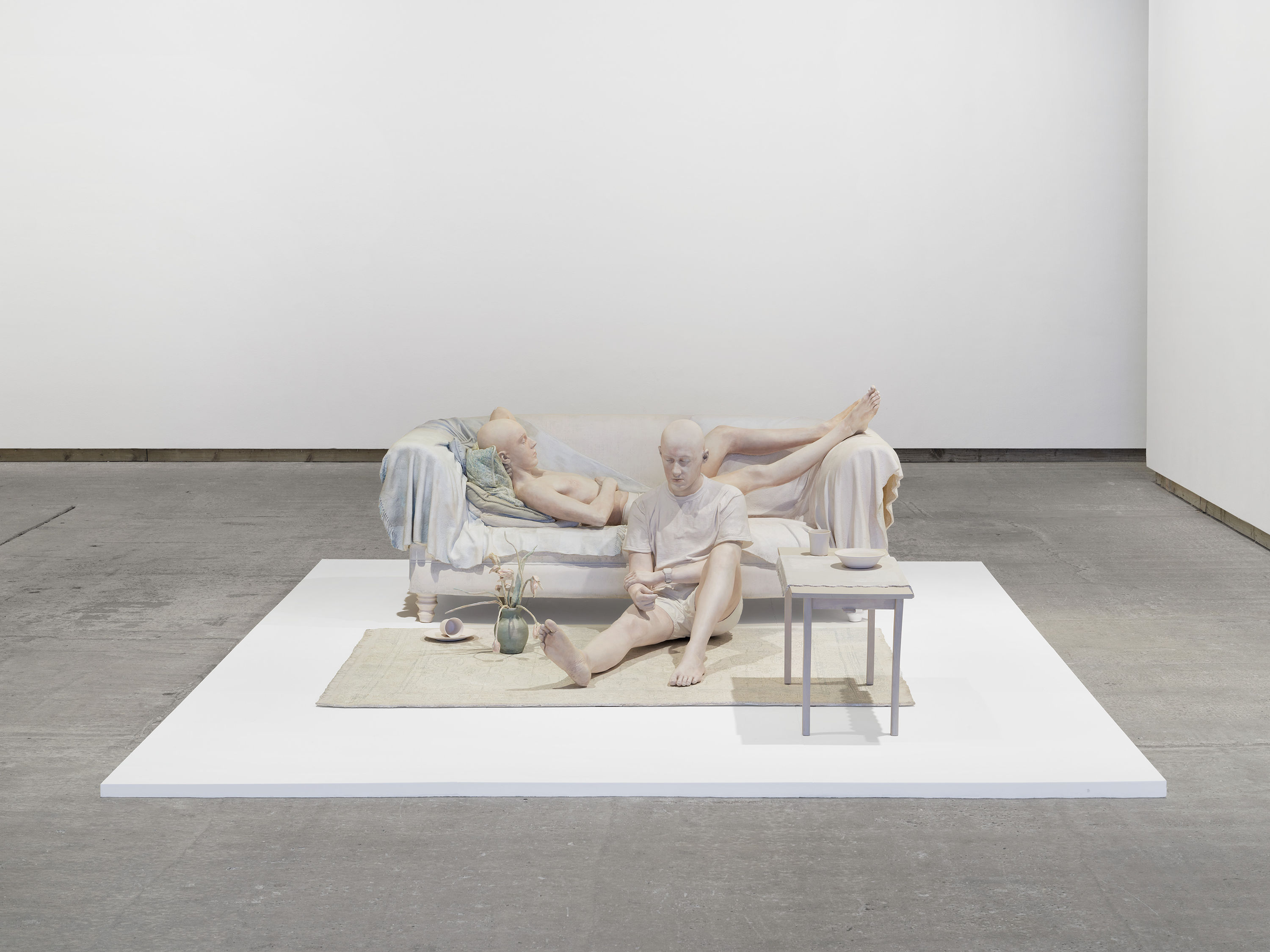
Sons and Couch, 2025
-
The exhibition features several new sculptures including an important installation, meticulously cast from life in Jesmonite, entitled Sons and Couch (2025). Here the artist returns to the subject of her two children, now on the cusp of adulthood, that she last portrayed on the brink of adolescence in 2014. As in other pieces the work meditates on passing time, the transience of life and more distinctly, the forging of individual identity.
Sons and Couch continues a series that started with Sons (2011), the earliest of the sculptures of her children when they were entering adolescence, followed by Kitchen Table (2014). Both pieces have been shown in previous solo shows at the gallery. In Sons and Couch the centre of domestic life has moved from the kitchen table to the living room couch where the bodies have grown and are once again captured at a time of change – a nuanced moment of possibility and perhaps anxiety rendered solid.
-
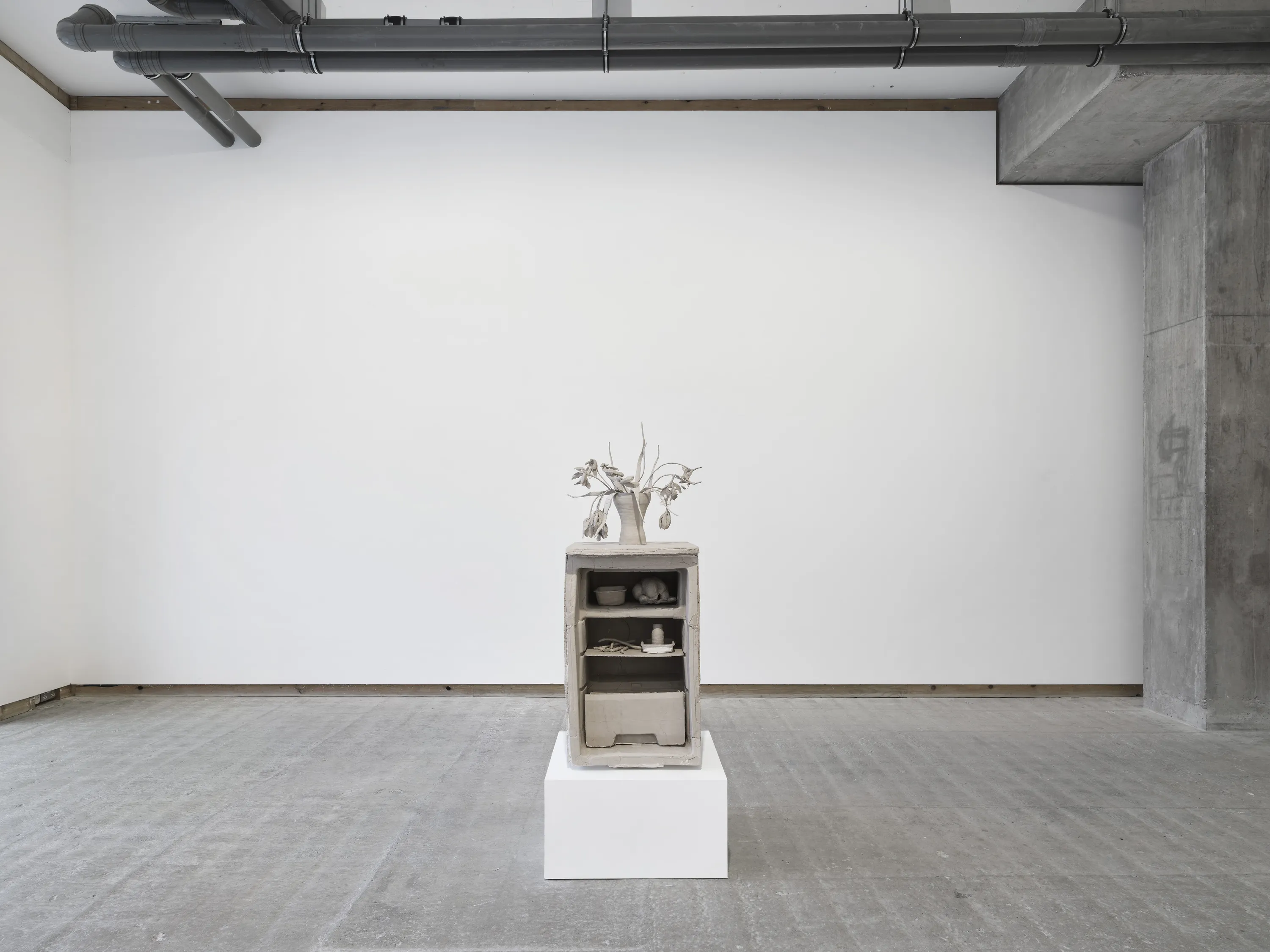
Fridge Still Life, 2021
-
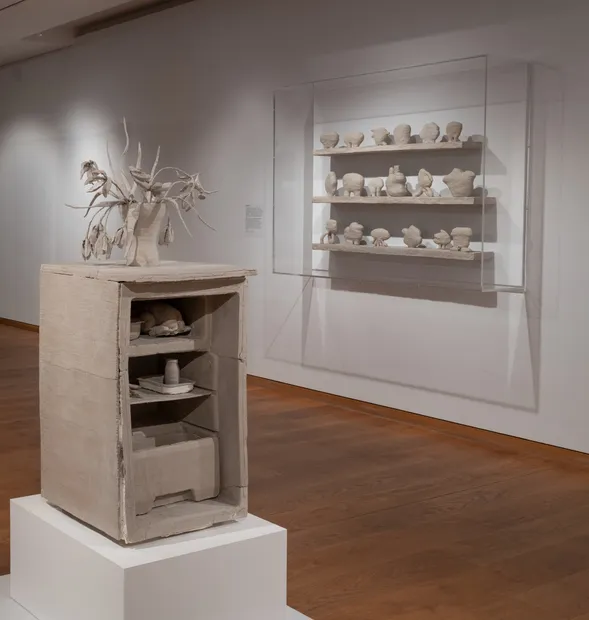
In contrast to the hard and robust Jesmonite pieces, Wright’s Fridge Still Life (2021) is an exercise in fragility. It is from a group of works made from unfired clay, a material which the artist has been using for the last fifteen years. Fridges are intended to slow down the effects of time, but they are also strangely intimate and revealing personal spaces. In this piece the viewer is invited to consider what is revealed by the oven-ready chicken, drinks bottle and five asparagus spears that sit forlornly in the fridge’s interior. The piece alludes directly to the mundane but evocative necessities of domestic life.
-
-
-
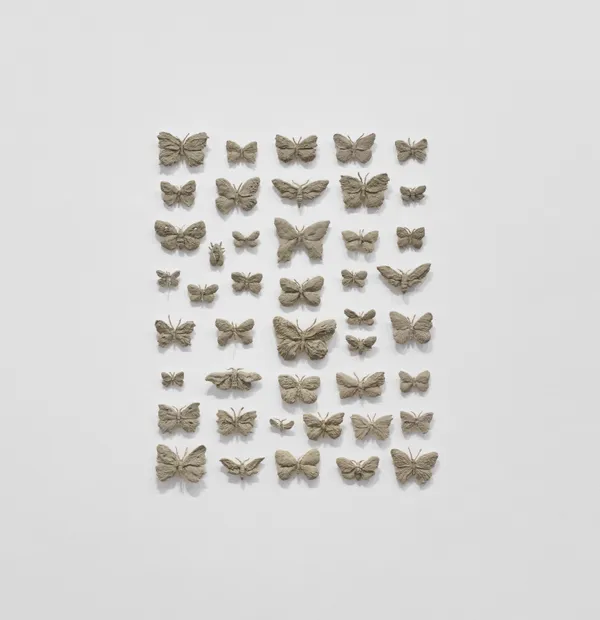
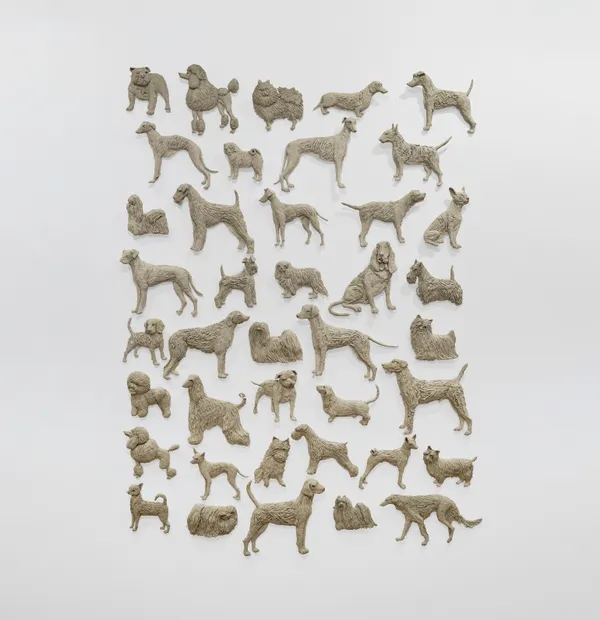
A different and touching example of intimate domesticity is suggested by a group of small wall-based sculptures of animals taken from collectible posters that once came free with the Guardian newspaper and were hung on the bedroom walls of Wright’s sons. In these pieces, carefully arranged silhouettes of dogs and butterflies have been recreated in low relief three dimensionality, an attempt to give form to the impulse of childhood imagination.
-
-
Also included in the exhibition is a series of new watercolours entitled Man Boys, 2026. Emphatically not portraits, the works are inspired by boys the artist knows. In these delicate pieces Wright attempts to capture the features of young males in flux. They are very hard to record at this age of late teens / early 20s, when their faces are in a process of change. Transformations are happening in their physiognomy which gives only a hint of their future selves but there still remains a glimpse of the child that was. Wright stresses how challenging the paintings were to make as the soft faces are so difficult to transcribe.
-
"[My work is about] the investigation of the human and human cycle through life. And the human within whatever institution that is, whether it’s a country, a family, an identity, a peer group. I’m always looking at how a human is operating.”
– Daphne Wright
-
-
-
-
Video by Jon Lowe
-
-
-
Photography: Ben Westoby / Fine Art Documentation
Daphne Wright: Deep-Rooted Things was on show at the Ashmolean Museum, Oxford until 8 February 2026 and was conceived in partnership with the Hugh Lane Gallery, Dublin. Many of these works were made possible with the help of The Arts Council of Ireland and Culture Ireland